Unix - Quick Guide
What is Unix ?
The Unix operating system is a set of programs that act as a link between the computer and the user.
The computer programs that allocate the system resources and coordinate all the details of the computer's internals is called the operating system or the kernel.
Users communicate with the kernel through a program known as the shell. The shell is a command line interpreter; it translates commands entered by the user and converts them into a language that is understood by the kernel.
Unix was originally developed in 1969 by a group of AT&T employees Ken Thompson, Dennis Ritchie, Douglas McIlroy, and Joe Ossanna at Bell Labs.
There are various Unix variants available in the market. Solaris Unix, AIX, HP Unix and BSD are a few examples. Linux is also a flavor of Unix which is freely available.
Several people can use a Unix computer at the same time; hence Unix is called a multiuser system.
A user can also run multiple programs at the same time; hence Unix is a multitasking environment.
Unix Architecture
Here is a basic block diagram of a Unix system −
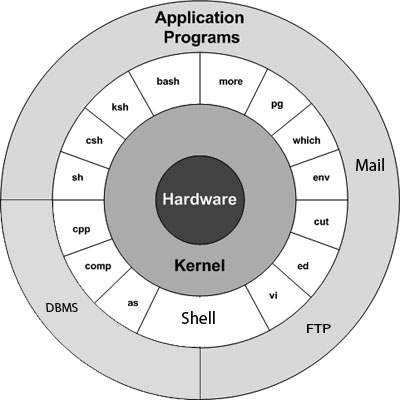
The main concept that unites all the versions of Unix is the following four basics −
Kernel − The kernel is the heart of the operating system. It interacts with the hardware and most of the tasks like memory management, task scheduling and file management.
Shell − The shell is the utility that processes your requests. When you type in a command at your terminal, the shell interprets the command and calls the program that you want. The shell uses standard syntax for all commands. C Shell, Bourne Shell and Korn Shell are the most famous shells which are available with most of the Unix variants.
Commands and Utilities − There are various commands and utilities which you can make use of in your day to day activities. cp, mv, catand grep, etc. are few examples of commands and utilities. There are over 250 standard commands plus numerous others provided through 3rd party software. All the commands come along with various options.
Files and Directories − All the data of Unix is organized into files. All files are then organized into directories. These directories are further organized into a tree-like structure called the filesystem.
System Bootup
If you have a computer which has the Unix operating system installed in it, then you simply need to turn on the system to make it live.
As soon as you turn on the system, it starts booting up and finally it prompts you to log into the system, which is an activity to log into the system and use it for your day-to-day activities.
Login Unix
When you first connect to a Unix system, you usually see a prompt such as the following −
login:
To log in
Have your userid (user identification) and password ready. Contact your system administrator if you don't have these yet.
Type your userid at the login prompt, then press ENTER. Your userid is case-sensitive, so be sure you type it exactly as your system administrator has instructed.
Type your password at the password prompt, then press ENTER. Your password is also case-sensitive.
If you provide the correct userid and password, then you will be allowed to enter into the system. Read the information and messages that comes up on the screen, which is as follows.
login : amrood amrood's password: Last login: Sun Jun 14 09:32:32 2009 from 62.61.164.73 $
You will be provided with a command prompt (sometime called the $ prompt ) where you type all your commands. For example, to check calendar, you need to type the cal command as follows −
$ cal June 2009 Su Mo Tu We Th Fr Sa 1 2 3 4 5 6 7 8 9 10 11 12 13 14 15 16 17 18 19 20 21 22 23 24 25 26 27 28 29 30 $
Change Password
All Unix systems require passwords to help ensure that your files and data remain your own and that the system itself is secure from hackers and crackers. Following are the steps to change your password −
Step 1 − To start, type password at the command prompt as shown below.
Step 2 − Enter your old password, the one you're currently using.
Step 3 − Type in your new password. Always keep your password complex enough so that nobody can guess it. But make sure, you remember it.
Step 4 − You must verify the password by typing it again.
$ passwd Changing password for amrood (current) Unix password:****** New UNIX password:******* Retype new UNIX password:******* passwd: all authentication tokens updated successfully $
Note − We have added asterisk (*) here just to show the location where you need to enter the current and new passwords otherwise at your system. It does not show you any character when you type.
Listing Directories and Files
All data in Unix is organized into files. All files are organized into directories. These directories are organized into a tree-like structure called the filesystem.
You can use the ls command to list out all the files or directories available in a directory. Following is the example of using ls command with -l option.
$ ls -l total 19621 drwxrwxr-x 2 amrood amrood 4096 Dec 25 09:59 uml -rw-rw-r-- 1 amrood amrood 5341 Dec 25 08:38 uml.jpg drwxr-xr-x 2 amrood amrood 4096 Feb 15 2006 univ drwxr-xr-x 2 root root 4096 Dec 9 2007 urlspedia -rw-r--r-- 1 root root 276480 Dec 9 2007 urlspedia.tar drwxr-xr-x 8 root root 4096 Nov 25 2007 usr -rwxr-xr-x 1 root root 3192 Nov 25 2007 webthumb.php -rw-rw-r-- 1 amrood amrood 20480 Nov 25 2007 webthumb.tar -rw-rw-r-- 1 amrood amrood 5654 Aug 9 2007 yourfile.mid -rw-rw-r-- 1 amrood amrood 166255 Aug 9 2007 yourfile.swf $
Here entries starting with d..... represent directories. For example, uml, univ and urlspedia are directories and rest of the entries are files.
Who Are You?
While you're logged into the system, you might be willing to know : Who am I?
The easiest way to find out "who you are" is to enter the whoami command −
$ whoami amrood $
Try it on your system. This command lists the account name associated with the current login. You can try who am i command as well to get information about yourself.
Who is Logged in?
Sometime you might be interested to know who is logged in to the computer at the same time.
There are three commands available to get you this information, based on how much you wish to know about the other users: users, who, and w.
$ users amrood bablu qadir $ who amrood ttyp0 Oct 8 14:10 (limbo) bablu ttyp2 Oct 4 09:08 (calliope) qadir ttyp4 Oct 8 12:09 (dent) $
Try the w command on your system to check the output. This lists down information associated with the users logged in the system.
Logging Out
When you finish your session, you need to log out of the system. This is to ensure that nobody else accesses your files.
To log out
Just type the logout command at the command prompt, and the system will clean up everything and break the connection.
System Shutdown
The most consistent way to shut down a Unix system properly via the command line is to use one of the following commands −
S.No.Command & Description1
halt
Brings the system down immediately
2
init 0
Powers off the system using predefined scripts to synchronize and clean up the system prior to shutting down
3
init 6
Reboots the system by shutting it down completely and then restarting it
4
poweroff
Shuts down the system by powering off
5
reboot
Reboots the system
6
shutdown
Shuts down the system
You typically need to be the super user or root (the most privileged account on a Unix system) to shut down the system. However, on some standalone or personally-owned Unix boxes, an administrative user and sometimes regular users can do so.
Unix - File Management
In this chapter, we will discuss in detail about file management in Unix. All data in Unix is organized into files. All files are organized into directories. These directories are organized into a tree-like structure called the filesystem.
When you work with Unix, one way or another, you spend most of your time working with files. This tutorial will help you understand how to create and remove files, copy and rename them, create links to them, etc.
In Unix, there are three basic types of files −
Ordinary Files − An ordinary file is a file on the system that contains data, text, or program instructions. In this tutorial, you look at working with ordinary files.
Directories − Directories store both special and ordinary files. For users familiar with Windows or Mac OS, Unix directories are equivalent to folders.
Special Files − Some special files provide access to hardware such as hard drives, CD-ROM drives, modems, and Ethernet adapters. Other special files are similar to aliases or shortcuts and enable you to access a single file using different names.
Listing Files
To list the files and directories stored in the current directory, use the following command −
$ls
Here is the sample output of the above command −
$ls bin hosts lib res.03 ch07 hw1 pub test_results ch07.bak hw2 res.01 users docs hw3 res.02 work
The command ls supports the -l option which would help you to get more information about the listed files −
$ls -l total 1962188 drwxrwxr-x 2 amrood amrood 4096 Dec 25 09:59 uml -rw-rw-r-- 1 amrood amrood 5341 Dec 25 08:38 uml.jpg drwxr-xr-x 2 amrood amrood 4096 Feb 15 2006 univ drwxr-xr-x 2 root root 4096 Dec 9 2007 urlspedia -rw-r--r-- 1 root root 276480 Dec 9 2007 urlspedia.tar drwxr-xr-x 8 root root 4096 Nov 25 2007 usr drwxr-xr-x 2 200 300 4096 Nov 25 2007 webthumb-1.01 -rwxr-xr-x 1 root root 3192 Nov 25 2007 webthumb.php -rw-rw-r-- 1 amrood amrood 20480 Nov 25 2007 webthumb.tar -rw-rw-r-- 1 amrood amrood 5654 Aug 9 2007 yourfile.mid -rw-rw-r-- 1 amrood amrood 166255 Aug 9 2007 yourfile.swf drwxr-xr-x 11 amrood amrood 4096 May 29 2007 zlib-1.2.3 $
Here is the information about all the listed columns −
First Column − Represents the file type and the permission given on the file. Below is the description of all type of files.
Second Column − Represents the number of memory blocks taken by the file or directory.
Third Column − Represents the owner of the file. This is the Unix user who created this file.
Fourth Column − Represents the group of the owner. Every Unix user will have an associated group.
Fifth Column − Represents the file size in bytes.
Sixth Column − Represents the date and the time when this file was created or modified for the last time.
Seventh Column − Represents the file or the directory name.
In the ls -l listing example, every file line begins with a d, -, or l. These characters indicate the type of the file that's listed.
S.No.Prefix & Description1
-
Regular file, such as an ASCII text file, binary executable, or hard link.
2
b
Block special file. Block input/output device file such as a physical hard drive.
3
c
Character special file. Raw input/output device file such as a physical hard drive.
4
d
Directory file that contains a listing of other files and directories.
5
l
Symbolic link file. Links on any regular file.
6
p
Named pipe. A mechanism for interprocess communications.
7
s
Socket used for interprocess communication.
Metacharacters
Metacharacters have a special meaning in Unix. For example, * and ? are metacharacters. We use * to match 0 or more characters, a question mark (?) matches with a single character.
For Example −
$ls ch*.doc
Displays all the files, the names of which start with ch and end with .doc −
ch01-1.doc ch010.doc ch02.doc ch03-2.doc ch04-1.doc ch040.doc ch05.doc ch06-2.doc ch01-2.doc ch02-1.doc c
Here, * works as meta character which matches with any character. If you want to display all the files ending with just .doc, then you can use the following command −
$ls *.doc
Hidden Files
An invisible file is one, the first character of which is the dot or the period character (.). Unix programs (including the shell) use most of these files to store configuration information.
Some common examples of the hidden files include the files −
.profile − The Bourne shell ( sh) initialization script
.kshrc − The Korn shell ( ksh) initialization script
.cshrc − The C shell ( csh) initialization script
.rhosts − The remote shell configuration file
To list the invisible files, specify the -a option to ls −
$ ls -a . .profile docs lib test_results .. .rhosts hosts pub users .emacs bin hw1 res.01 work .exrc ch07 hw2 res.02 .kshrc ch07.bak hw3 res.03 $
Single dot (.) − This represents the current directory.
Double dot (..) − This represents the parent directory.
Creating Files
You can use the vi editor to create ordinary files on any Unix system. You simply need to give the following command −
$ vi filename
The above command will open a file with the given filename. Now, press the key i to come into the edit mode. Once you are in the edit mode, you can start writing your content in the file as in the following program −
This is unix file....I created it for the first time..... I'm going to save this content in this file.
Once you are done with the program, follow these steps −

No comments:
Post a Comment