Biometrics - Overview
The term Biometrics is composed of two words − Bio (Greek word for Life) and Metrics (Measurements). Biometrics is a branch of information technology that aims towards establishing one’s identity based on personal traits.
Biometrics is presently a buzzword in the domain of information security as it provides high degree of accuracy in identifying an individual.
What is Biometrics?
Biometrics is a technology used to identify, analyze, and measure an individual’s physical and behavioral characteristics.
Each human being is unique in terms of characteristics, which make him or her different from all others. The physical attributes such as finger prints, color of iris, color of hair, hand geometry, and behavioral characteristics such as tone and accent of speech, signature, or the way of typing keys of computer keyboard etc., make a person stand separate from the rest.
This uniqueness of a person is then used by the biometric systems to −
Identify and verify a person.Authenticate a person to give appropriate rights of system operations.Keep the system safe from unethical handling.
What is a Biometric System?
A biometric system is a technology which takes an individual’s physiological, behavioral, or both traits as input, analyzes it, and identifies the individual as a genuine or malicious user.
Evolution of Biometrics
The idea of biometrics was present since few years from now. In 14th century, China practiced taking finger prints of merchants and their children to separate them from all others. Fingerprinting is still used today.
In the 19th century, an Anthropologist named Alphonse Bertilliondeveloped a method (named Bertillionage) of taking body measurements of persons to identify them. He had realized that even if some features of human body are changed, such as length of hair, weight, etc., some physical traits of body remain unchanged, such as length of fingers. This method diminished quickly as it was found that the persons with same body measurements alone can be falsely taken as one. Subsequently, Richard Edward Henry from Scotland Yard developed a method for fingerprinting.
The idea of retinal identification was conceived by Dr. Carleton Simon and Dr. Isadore Goldstein in 1935. In 1976, a research and development effort was put in at EyeDentify Inc. The first commercial retina scanning system was made available in 1981.
Iris recognition was invented by John Daugman in 1993 at Cambridge University.
In 2001, Biometrics Automated Toolset (BAT) was introduced in Kosovo, which provided a concrete identification means.
Today, biometric has come up as an independent field of study with precise technologies of establishing personal identities.
Why Biometrics is Required?
With increasing use of Information Technology in the field of banking, science, medication, etc., there is an immense need to protect the systems and data from unauthorized users.
Biometrics is used for authenticating and authorizing a person. Though these terms are often coupled; they mean different.
Authentication (Identification)
This process tries to find out answer of question, “Are you the same who you are claiming to be?”, or, “Do I know you?” This is one-to-many matching and comparison of a person’s biometrics with the whole database.
Verification
This is the one-to-one process of matching where live sample entered by the candidate is compared with a previously stored template in the database. If both are matching with more than 70% agreeable similarity, then the verification is successful.
Authorization
It is the process of assigning access rights to the authenticated or verified users. It tries to find out the answer for the question, “Are you eligible to have certain rights to access this resource?”
Shortcomings of Conventional Security Aids
The conventional methods of information system security used ID cards, passwords, Personal Identification Numbers (PINs), etc. They come with the following disadvantages −
They all mean recognizing some code associated with the person rather than recognizing the person who actually produced it.
They can be forgotten, lost, or stolen.
They can be bypassed or easily compromised.
They are not precise.
In such cases, the security of the system is threatened. When the systems need high level of reliable protection, biometrics comes to help by binding the identity more oriented to individual.
Basic Components of a Biometric System
In general, a biometric system can be divided into four basic components. Let us see them briefly −
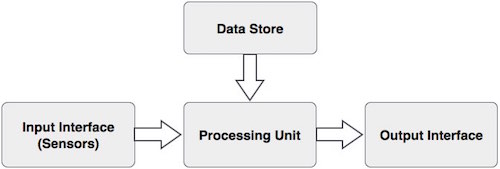
Input Interface (Sensors)
It is the sensing component of a biometrics system that converts human biological data into digital form.
For example,
A Metal Oxide Semiconductor (CMOS) imager or a Charge Coupled Device (CCD) in the case of face recognition, handprint recognition, or iris/retinal recognition systems.
An optical sensor in case of fingerprint systems.
A microphone in case of voice recognition systems.
Processing Unit
The processing component is a microprocessor, Digital Signal Processor (DSP), or computer that processes the data captured from the sensors.
The processing of the biometric sample involves −
Sample image enhancementSample image normalizationFeature extractionComparison of the biometric sample with all stored samples in database.
Database Store
The database stores the enrolled sample, which is recalled to perform a match at the time of authentication. For identification, there can be any memory from Random Access Memory (RAM), flash EPROM, or a data server. For verification, a removable storage element like a contact or contactless smart card is used.
Output Interface
The output interface communicates the decision of the biometric system to enable the access to the user. This can be a simple serial communication protocol RS232, or the higher bandwidth USB protocol. It could also be TCP/IP protocol, Radio Frequency Identification (RFID), Bluetooth, or one of the many cellular protocols.
General Working of a Biometric System
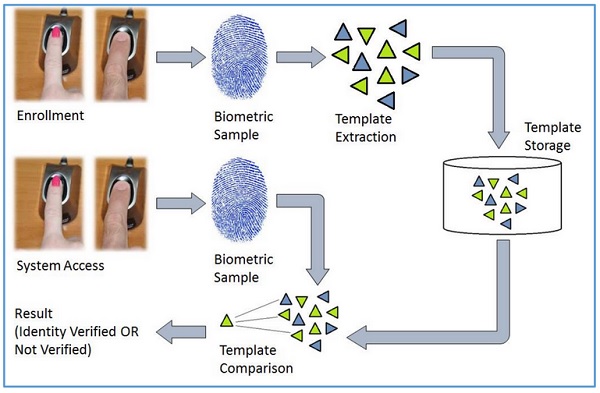
There are four general steps a biometric system takes to perform identification and verification −
Acquire live sample from candidate. (using sensors)Extract prominent features from sample. (using processing unit)Compare live sample with samples stored in database. (using algorithms)Present the decision. (Accept or reject the candidate.)
The biometric sample is acquired from candidate user. The prominent features are extracted from the sample and it is then compared with all the samples stored in the database. When the input sample matches with one of the samples in the database, the biometric system allows the person to access the resources; otherwise prohibits.
Biometrics Terminology
Biometric Template − It is a digital reference of the distinct characteristics that are extracted from a biometric sample.
Candidate/Subject − A person who enters his biometric sample.
Closed-Set Identification − The person is known to be existing in the database.
Enrollment − It is when a candidate uses a biometric system for the first time, it records the basic information such as name, address, etc. and then records the candidate’s biometric trait.
False Acceptance Rate (FAR) − It is the measure of possibility that a biometric system will incorrectly identify an unauthorized user as a valid user.
FAR =
Number of False Acceptances / Number of Identification Attempts
A biometric system providing low FAR ensures high security.
False Reject Rate (FRR) − It is the measure of possibility that the biometric system will incorrectly reject an authorized user as an invalid user.
FRR =
Number of False Rejections / Number of Identification Attempts
Open-Set Identification − The person is not guaranteed to be existing in the database.
Task − It is when the biometric system searches the database for matching sample.
Application Areas of Biometrics
There are a number of applications where biometric systems are useful. Few of them are given below −
Controlling workplace access.
Identity establishment of people for authentic citizenship and immigration systems.
Applying access control to sensitive information and systems.
Identifying criminals by forensics.
Executing online e-commerce transactions.
Fraud and theft reduction.
Law enforcement.
Biometrics - Modalities
A biometric modality is nothing but a category of a biometric system depending upon the type of human trait it takes as input.
The biometrics is largely statistical. The more the data available from sample, the more the system is likely to be unique and reliable. It can work on various modalities pertaining to measurements of individual’s body and features, and behavioral patterns. The modalities are classified based on the person’s biological traits.
Types of Biometric Modalities
There are various traits present in humans, which can be used as biometrics modalities. The biometric modalities fall under three types −
PhysiologicalBehavioralCombination of physiological and behavioral modality
The following table collects the points that differentiate these three modalities −
Physiological ModalityBehavioral ModalityCombination of Both ModalitiesThis modality pertains to the shape and size of the body.This modality is related to change in human behavior over time.This modality includes both traits, where the traits are depending upon physical as well as behavioral changes.
For example −
Fingerprint RecognitionHand Geometry Recognition systemFacial Recognition SystemIris Recognition SystemHand Geometry Recognition SystemRetinal Scanning SystemDNA Recognition System
For example −
Gait (the way one walks)Rhythm of typing keysSignature
For example −
Voice Recognition
It depends on health, size, and shape of vocal cord, nasal cavities, mouth cavity, shape of lips, etc., and the emotional status, age, illness (behavior) of a person.
In the subsequent chapters, we will discuss each of these modalities in greater detail.
Physiological Modalities
As depicted earlier, the physiological modalities are based on the direct measurement of parts of human body such as iris, fingerprint, shape, and position of fingers, etc.
There are some physical traits which remain unaltered throughout a person’s life. They can be an excellent resource for identification of an individual.
Fingerprint Recognition System
It is the most known and used biometrics solution to authenticate people on biometric systems. The reasons for it being so popular are there are ten available sources of biometric and ease of acquisition.
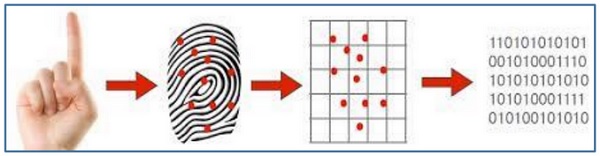
Every person has a unique fingerprint which is composed of ridges, grooves, and direction of the lines. There are three basic patterns of ridges namely, arch, loop, and whorl. The uniqueness of fingerprint is determined by these features as well as minutiae features such as bifurcation and spots (ridge endings).
Fingerprint is one of oldest and most popular recognition technique. Fingerprint matching techniques are of three types −
Minutiae Based Techniques − In these minutiae points are found and then mapped to their relative position on finger. There are some difficulties such as if image is of low quality, then it is difficult to find minutiae points correctly. Another difficulty is, it considers local position of ridges and furrows; not global.
Correlation Based Method − It uses richer gray scale information. It overcomes problems of minutiae-based method, by being able to work with bad quality data. But it has some of its own problems like localization of points.
Pattern Based (Image Based) Matching − Pattern based algorithms compare the basic fingerprint patterns (arch, whorl, and loop) between a stored template and a candidate fingerprint.
Merits of Finger Recognition System
It is the most contemporary method.It is most economical method.It is highly reliable and secure.It works on a small template size, which speeds up the verifying process.It consumes less memory space.
Demerits of Finger Recognition System
Scars, cuts or absence of finger can hinder the recognition process.The systems can be fooled by using artificial finger made of wax.It involves physical contact with the system.They leave the pattern of finger behind at the time of entering sample.
Applications of Finger Recognition System
Verification of driver-license authenticity.Checking validity of driving license.Border Control/Visa Issuance.Access control in organizations.
Facial Recognition System
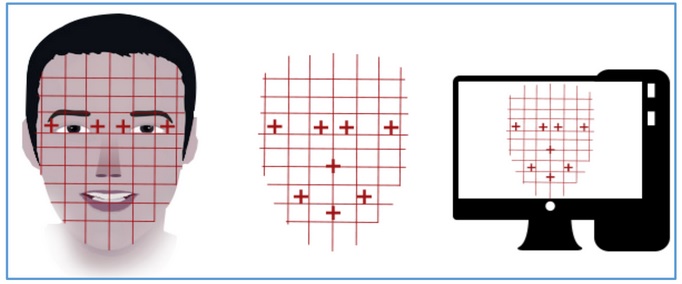
Facial recognition is based on determining shape and size of jaw, chin, shape and location of the eyes, eyebrows, nose, lips, and cheekbones. 2D facial scanners start reading face geometry and recording it on the grid. The facial geometry is transferred to the database in terms of points. The comparison algorithms perform face matching and come up with the results. Facial recognition is performed in the following ways −
Facial Metrics − In this type, the distances between pupils or from nose to lip or chin are measured.
Eigen faces − It is the process of analyzing the overall face image as a weighted combination of a number of faces.
Skin Texture Analysis − The unique lines, patterns, and spots apparent in a person’s skin are located.
Merits of Facial Recognition System
It offers easy storage of templates in database.It reduces the statistic complexities to recognize face image.It involves no physical contact with the system.
Demerits of Facial Recognition System
Facial traits change over time.Uniqueness is not guaranteed, for example, in case of identical twins.If a candidate face shows different expressions such as light smile, then it can affect the result.It requires adequate lighting to get correct input.
Applications of Facial Recognition System
General Identity Verification.Verification for access control.Human-Computer Interaction.Criminal Identification.Surveillance.
Iris Recognition System
Iris recognition works on the basis of iris pattern in human eye. The iris is the pigmented elastic tissue that has adjustable circular opening in center. It controls the diameter of pupil. In adult humans, the texture of iris is stable throughout their lives. The iris patterns of left and right eyes are different. The iris patterns and colors change from person to person.
It involves taking the picture of iris with a capable camera, storing it, and comparing the same

No comments:
Post a Comment